
Reviewed · WORKSHOPS
Hanoi Knife Making Traditional Workshop
A real hammer day outside Hanoi. In Dong Bac at the Da Sy forging village, you’ll watch Vietnamese metalwork from sketch to a finished blade.
What I like most is how practical it is: you don’t just sit and watch. I also love the human touch, from English-speaking guides like Tee, Nathan, Khoi, and Minh to patient artisans such as Mrs. Tuyen (Do Thi Tuyen), who show the steps and guide your hands.
One thing to consider: hands-on doesn’t always mean hands-on 100 percent. You’ll do a lot yourself, but the workshop may run some of the most dangerous machine steps for safety, and you might be offered different participation levels.
In This Review
- Key highlights to know before you go
- Getting from Hanoi into Dong Bac and the Da Sy workshop
- Choosing your knife design before any steel heats up
- Sketching and forging: hammering your way through the hardest part
- Shaping and trimming: where the knife starts looking like a knife
- Grinding and sharpening: the tar-based wash step that makes it work
- Handles, tempering, and the part people remember most
- What’s included, what you bring, and what rules to follow
- Price and value: is $50 for 3 hours fair?
- Who should book this Hanoi knife class
- Should you book the Hanoi Knife Making Workshop in Dong Bac?
- FAQ
- How much does the Hanoi Knife Making Workshop cost?
- How long is the workshop?
- Where does the workshop take place?
- Do I get picked up from my hotel?
- Is the instruction available in English?
- What will I actually do during the knife making?
- Is water included?
- What should I wear or bring?
- Is the workshop suitable for very elderly participants?
- Are alcohol and drugs allowed?
- Is there any extra fee on holidays?
Key highlights to know before you go
- Pick your knife style early: you can choose a shape from options or based on what you want your final knife to be like.
- You follow the full process: from design and cutting out the blade to grinding and sharpening.
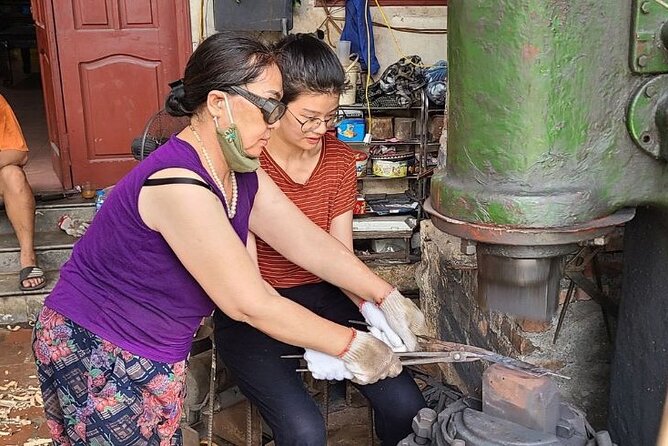
- Forge work with real supervision: you’ll hammer and shape metal, alternating blows with the maker while staying safe.
- Sharpening includes a special wash step: the process uses a tar-based chemical wash as part of the sharpening phases.
- You can make more than the blade: many people carve and finish the handle, then fit it into a practical final tool.
- It’s great value for the time: the price includes a guide, water, transport pickup, and the end product.
Getting from Hanoi into Dong Bac and the Da Sy workshop
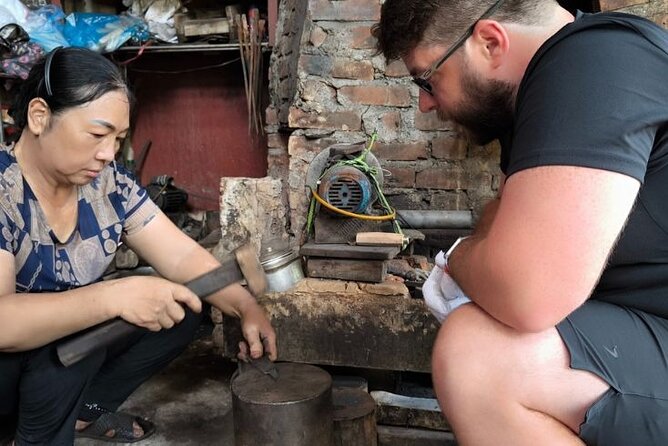
This is one of those Hanoi activities that feels like a day trip without feeling like a chore. Your day starts with hotel pickup, then a drive out toward Dong Bac and the craft village area where knife and metalwork traditions live. The workshop portion takes about 3 hours, and you can find starting times by checking what’s available when you book.
Logistics matter here, because the whole point is making. A smooth transfer means you spend more time in the shop and less time figuring out what happens next. In the best runs, the guide keeps you comfortable and helps with translation, and you arrive ready to do the work.
Group size is kept small, which helps a lot in a hands-on environment. When the group is small, the master can watch your technique, and the guide can keep instructions clear and safe.
Worth a glance beside this Hanoi pick:




Choosing your knife design before any steel heats up
You start with the fun part: deciding what you want to make. Many classes let you select the blade shape and style from a set of options, and some setups also let you base your choice on something you like, sometimes even using a photo for reference.
This matters more than you might think. A simple design choice can affect everything that follows: the way the tang fits, how you’ll shape the bevel, and how the finished knife will feel in hand. It also makes the workshop feel personal. By the time you’re forging, you’re working toward something you actually chose.
Guides such as Tee, Nathan, Khoi, and Minh are known for strong English translation, and that’s a big deal when your goal is to understand the why behind each step, not just repeat actions you don’t fully grasp. If you’re worried about not speaking Vietnamese, this is the part that should ease your mind.
Sketching and forging: hammering your way through the hardest part
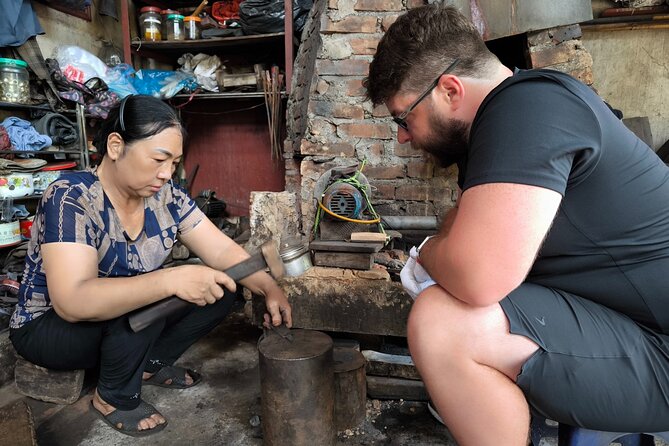
Knife making in this class follows a clear sequence. First comes the design step, where you sketch the blade shape on a metal sheet chosen for durability. Then you move into the forging stage.
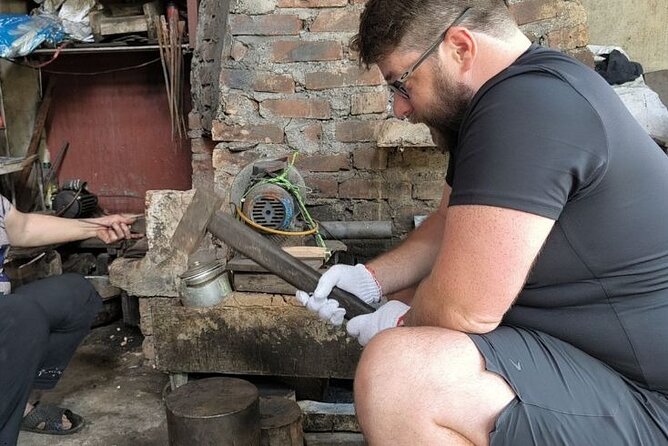
In the forging part, you’ll cut out the blade and tang (the part that goes into the handle). The metal goes into the embers, and then you begin shaping with a hammer. You won’t just swing randomly. The maker teaches how to coordinate blows and how to correct issues as they appear. Several people also describe alternating strikes with the artisan, which makes sense: it helps control the metal and keeps the work from drifting.
Safety is a real theme. One review described options for how much of the work you do yourself, and that there can be a step involving a very dangerous machine where staff control the process. Even if you’re eager to do everything, you’ll get help when it’s needed, and you’ll be guided so you don’t go too far off track.
Practical tip: wear comfortable shoes. And when they offer protective gear like gloves, use it. You’re working near heat and tools, and the workshop is built around doing this carefully.
Shaping and trimming: where the knife starts looking like a knife
After forging, the blade needs refinement. The class includes a shaping phase where you keep adjusting the blade through repeated hammering and careful work. If there are imperfections, they’re trimmed using a hydraulic cutting machine.
This is one of the key moments to appreciate. A lot of DIY experiences let you “do something,” then leave the real finishing for someone else. Here, the shaping stage is part of what you experience, but trimming the final geometry may be handled with precision tools to keep the shape accurate and consistent.
That’s also why the knife comes out looking more professional than the average souvenir. You’re not just walking away with a novelty metal object; you’re seeing how artisans correct a blade into something usable.
Grinding and sharpening: the tar-based wash step that makes it work
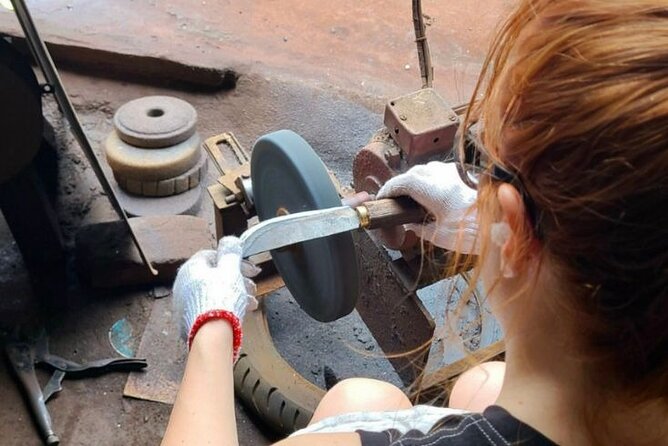
Once the blade has its basic form, it moves into grinding and sharpening. You’ll sharpen on a grindstone, and the sharpening phases include a step where the blade is soaked in a special tar-based chemical wash. The process uses a family recipe, and that detail is the kind of behind-the-scenes craft secret you almost never hear in a typical tourist workshop.
This stage is what turns your work into something you can actually use. Reviews consistently mention knives that end up quite sharp, including kitchen-ready knives for people who bought theirs for practical daily use, not just display. Even better: you learn that sharpening isn’t one motion. It’s a sequence.
If you’re the type who likes tactile results, pay attention here. The maker’s guidance and your own hands-on time shape the final edge quality. It’s also the part where you can see the value of doing the whole process, not just forging a hot chunk of metal.
- Hanoi Motorbike Tour: Food, Culture and Fun by Vintage Motorbike★ 5.0 · 6,699 reviews
- Hanoi: Guided Food Tour with Train Street Visit★ 4.9 · 6,239 reviews
- Hanoi Cooking Class: Culture, Local Market & Meaning CSR Impact★ 5.0 · 5,147 reviews
Handles, tempering, and the part people remember most
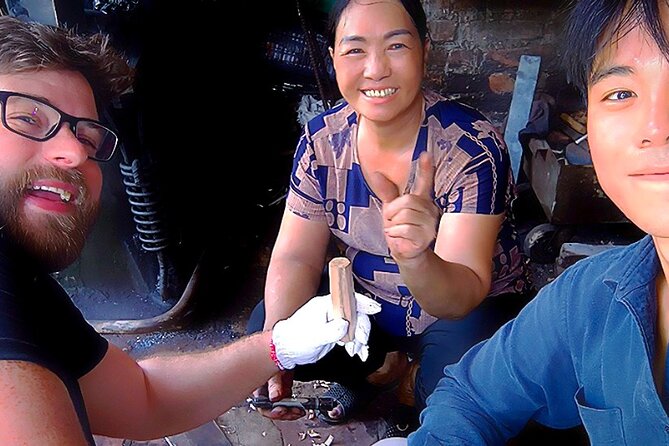
Knife making isn’t only about the blade. Many people leave talking about the handle, too. Some sessions include carving and finishing the wooden handle so the knife fits the way you grip it. That’s a small detail that changes the whole feel of the souvenir. It goes from purchased artifact to personal tool.
Some descriptions from past participants also mention tempering the metal during the process. Even if you don’t track every metallurgical term, you can still feel the difference between a blade that’s just formed and a blade that’s made to hold its edge.
As the class progresses, you’ll also likely get a tour of the workshop area and learn how the shop runs day to day. Reviews note shop walkthroughs over tea and snacks, and it’s a nice way to slow down after the hard work and see where knives like yours go next.
What’s included, what you bring, and what rules to follow
Here’s what the class includes based on the activity details:
- English-speaking instruction and a live tour guide
- A master artisan
- Equipment for the workshop activities
- Products, meaning you take home what you make
- Water: 1 bottle (500 ml)
What you should bring is simple: comfortable shoes. That’s not a throwaway line. You’ll spend time standing, and forging steps mean you’re closer to the action than you’d be in a museum setting.
Rules are also clear: alcohol and drugs are not allowed. If you’re thinking of celebrating with beers later, plan that for after. This is a shop floor with heat, tools, and safety boundaries.
Holiday note: there’s a $10 surcharge on New Year, Tet holidays, Liberation Day/Reunification Day (30/4), International Workers’ Day (01/05), and National Day (02/09). If your dates land on one of those, factor it into your budget.
Price and value: is $50 for 3 hours fair?
At $50 per person for around 3 hours, this can feel like an honest deal, especially because you’re not paying for observation. The experience includes transportation pickup from your hotel, a guide to handle English translation, water, equipment, and the finished product you take home.
In many craft classes elsewhere, you might pay for a demonstration plus a small takeaway. Here, you’re actively making a knife through multiple steps: design, forging/shaping, grinding and sharpening, and often handle work too. That combination is why the experience tends to land as good value rather than just a fun photo stop.
The other value lever is skill. The master artisans involved are the ones doing the work you can’t replicate at home. And you get to learn by doing under supervision. If you’re choosing between a “watch-and-buy” souvenir day and a “hands-on tool day,” this one leans heavily toward the second option.
Who should book this Hanoi knife class
This class fits best if you want a hands-on culture activity that’s not complicated. You don’t need DIY experience to participate. The key requirement is willingness: to follow instructions, use safety gear, and accept that staff may control the most dangerous equipment steps.
It also suits couples and small groups who like doing something together. With small groups, the guide can translate clearly and the master can correct your technique before you repeat an error for too long.
Families with teens often find it engaging, since it’s active and the result is something you can hold immediately after the workshop. And if you love cooking, a sharp kitchen knife is a practical souvenir that gets used, not stored.
If you dislike physical work or you’re mainly interested in watching from a distance, you might find parts of the day focused on supervised making rather than pure sightseeing.
Should you book the Hanoi Knife Making Workshop in Dong Bac?
If you want a souvenir with real craft behind it, I’d book it. The experience is built around you doing multiple stages of the process, with clear English support from guides like Tee, Nathan, Khoi, and Minh, and instruction from masters such as Do Thi Tuyen. You’ll come away with a knife you can actually use, not just something symbolic.
I’d skip it only if you’re expecting a full DIY workshop where you control every single tool step without limitations. Safety matters here, and you may be offered choices about how hands-on you want to be, especially around any dangerous machine work.
For most people, though, it’s a standout kind of Hanoi day: practical, memorable, and grounded in the real work of a forging village.
FAQ
How much does the Hanoi Knife Making Workshop cost?
It costs $50 per person.
How long is the workshop?
The duration is about 3 hours. Starting times depend on availability.
Where does the workshop take place?
The activity is in Dong Bac, Vietnam, in the Da Sy village area known for forging.
Do I get picked up from my hotel?
Yes, pickup is included. You should wait in the hotel lobby about 5 minutes before pickup.
Is the instruction available in English?
Yes. There is an English-speaking live tour guide and English instruction.
What will I actually do during the knife making?
You go through the processes of making a simple knife, including design sketching, forging and shaping, sharpening on a grindstone, and steps in the sharpening phases (including a tar-based chemical wash).
Is water included?
Yes. You receive 1 bottle of water (500 ml).
What should I wear or bring?
Bring comfortable shoes. That’s the main item listed for what to bring.
Is the workshop suitable for very elderly participants?
It is not suitable for people over 95 years old.
Are alcohol and drugs allowed?
No. Alcohol and drugs are not allowed.
Is there any extra fee on holidays?
Yes. There is a $10 surcharge on New Year, Tet holidays, Liberation Day/Reunification Day (30/4), International Workers’ Day (01/05), and National Day (02/09).
More Workshops in Hanoi


More Tour Reviews in Hanoi






Latest Hanoi write-ups from our team





Workshops, compared.
 ★ 5.0Hanoi Cooking Class: Culture, Local Market & Meaning CSR ImpactFrom $395,147 reviews
 ★ 5.05 Traditional Dishes Hanoi Cooking Class with Market TripFrom $354,890 reviews
 ★ 5.0Hanoi Coffee Workshop: Taste Salt, Coconut and Egg CoffeeFrom $161,286 reviews
 ★ 5.0Salt Coffee Workshop Awake Your Senses With 6 BrewsFrom $23792 reviews
 ★ 5.0Vietnamese Food Cooking Class in Hanoi with Market ExperienceFrom $45778 reviews
 ★ 5.0Handcrafted Wood Carving Workshop with Local ArtisanFrom $19733 reviews
 ★ 5.05 Local Dishes Cooking Class with Meal & Market VisitFrom $40420 reviews
 ★ 5.0Hanoi Cooking Class and Market Tour in Ancient HouseFrom $45379 reviews
Browse the lists this tour appears in