
Reviewed · WORKSHOPS
Hanoi Knife Making Traditional Workshop
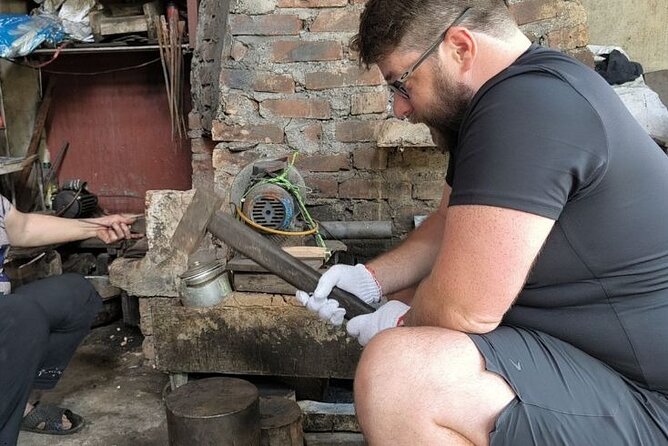
A hammer makes a great souvenir. In Hanoi, this traditional workshop takes you out to a forging village on the outskirts and walks you through the full process. What I like most is the hands-on way you learn the steps, and how the family makers keep things patient and practical.
You’ll spend about 3 hours 30 minutes working through design, forging, shaping, and sharpening. The main thing to consider is that the activity lists a moderate physical fitness level, and it also doesn’t include lunch, so you’ll want to plan food before or after.
In This Review
- Key things you’ll notice
- Hanoi Knife Making in a Real Craft Village
- Getting There: Hanoi Pickup and the Trip to the Outskirts
- The Workshop Flow: Design to Blade Shape
- Design: sketching the blade on metal
- Forging: cutting out the blade and tang in embers
- Shaping: hammering into form, trimming with machines
- Sharpening and the Tar Wash Step
- What You’ll Take Home (and How to Think About It)
- Price and Value: Is $50 a Good Deal?
- Timing, Weather, and How to Plan Your Hanoi Day
- Who This Hanoi Knife Workshop Is For
- Should You Book This Hanoi Knife Making Class?
- FAQ
- Is the knife making workshop physically demanding?
- How long does the Hanoi knife making class last?
- Does this tour offer pickup in Hanoi?
- What’s included in the $50 price?
- How many people are in the group?
- What happens if weather is bad or you need to cancel?
Key things you’ll notice
- A small group (max 10) means more attention while you’re working the tools.
- English guidance from Nathan helps if you want the craft explained clearly.
- Full step-by-step knife making covers design, forging, shaping, and sharpening.
- A secret family tar-based chemical wash is part of the sharpening phases.
- Pickup plus an air-conditioned vehicle makes the trip out of central Hanoi easier.
- You can choose your knife size, so it feels more like your own project than a demo.
Hanoi Knife Making in a Real Craft Village
This isn’t a stage show. You go to a village known for forging, where the craft has been around for several hundred years. Historically, this area made weapons during the Vietnam wars. Today, the same forging know-how is used to make agricultural tools—so the tradition didn’t vanish. It shifted.
What makes the experience feel real is the format. You start with conversation and local context, then you get your hands involved as the process unfolds. Instead of watching someone else do the hard part, you follow the steps of making a simple knife from scratch. And yes, the goal is to take a knife home.
One more nice detail: the workshop uses an English tour guide, and one guide named Nathan comes up in feedback as patient and engaging. That matters if your Vietnamese is limited and you want to understand what each step is doing.
Worth a glance beside this Hanoi pick:




Getting There: Hanoi Pickup and the Trip to the Outskirts
The day starts in Hanoi, with pickup offered. You ride in an air-conditioned vehicle, which is a big quality-of-life win in Vietnam heat. Then you head out to the forging village on the outskirts of the city.
You only have one main stop in the schedule, so don’t expect a long sightseeing day. This is focused. The drive is basically your transition from city life into workshop life—then you stay in that world until it’s time to wrap up and go back.
If you’re the type who hates rushed schedules, this helps. It’s a half-day style activity, not a full-day circuit. If you’re building an itinerary for Hanoi, it can fit nicely between lighter city exploring.
The Workshop Flow: Design to Blade Shape
The class is structured around the major stages of traditional knife making. You don’t just learn terms—you see how each step turns metal into a blade.
Design: sketching the blade on metal
You begin by sketching the blade shape on a sheet of metal. The metal is chosen for durability, and you pick the shape that matches what you want your knife to become. This is the moment where the craft feels personal. Even if you’re not an artist, you’re doing an actual first step that influences everything afterward.
If you’ve ever bought a tool and thought, I wonder how this gets made, this is the part that scratches that itch.
Forging: cutting out the blade and tang in embers
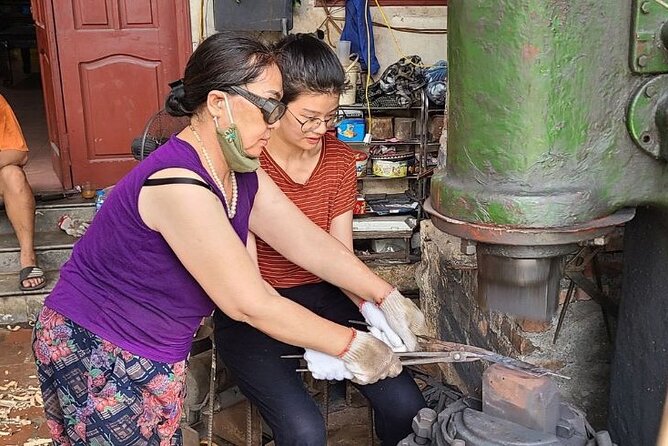
Next comes the dramatic, hands-on forging stage. Using hammer, cutter, and anvil, you cut out the blade and the tang (the section that extends into the handle). Then the pieces get worked in the heat of crackling embers.
This is also where you start learning why knife making isn’t instant gratification. Shaping metal takes time, patience, and repetition. The guidance here is key. Feedback highlights that family members are patient and helpful, which makes a difference if you’ve never used forging tools before.
- Hanoi Motorbike Tour: Food, Culture and Fun by Vintage Motorbike★ 5.0 · 6,699 reviews
- Hanoi: Guided Food Tour with Train Street Visit★ 4.9 · 6,239 reviews
- Hanoi Cooking Class: Culture, Local Market & Meaning CSR Impact★ 5.0 · 5,147 reviews
Shaping: hammering into form, trimming with machines
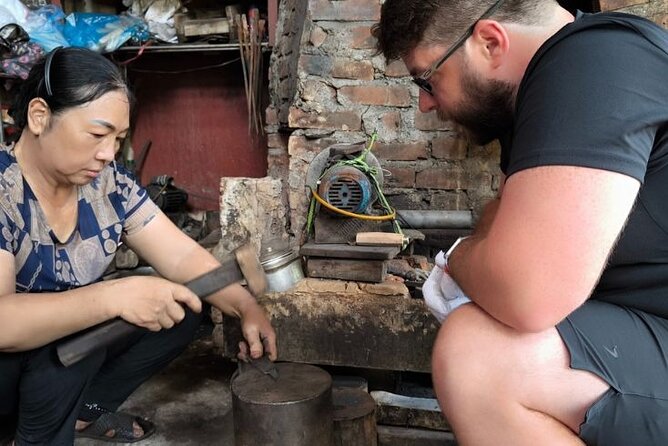
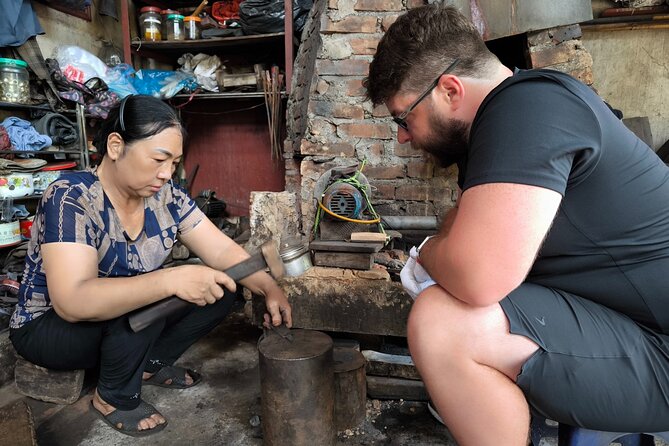
After forging, you alternate blows with the maker to shape the blade. Any imperfections are then trimmed by a hydraulic cutting machine.
That pairing is interesting in a practical way. It keeps the experience authentic while still showing you modern tools used for cleanup and accuracy. So you get the traditional work without the frustration of trying to make everything perfect with only hand tools.
Sharpening and the Tar Wash Step
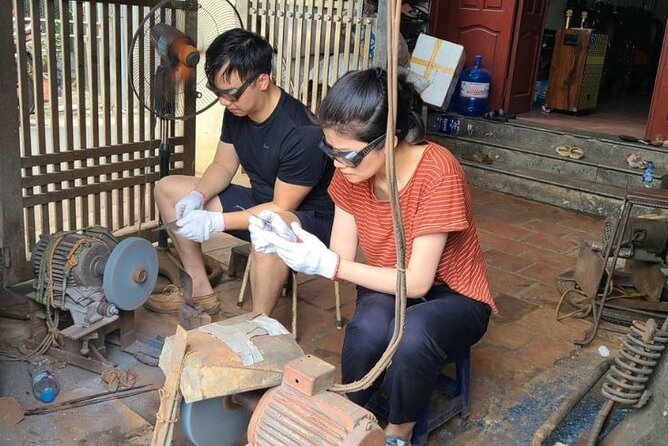
Sharpening is where a knife turns from a shaped piece of metal into a tool you can actually use. The workshop uses a grindstone and includes several phases.
One of the most talked-about parts is that during the sharpening process, the blade goes through a phase involving a tar-based chemical wash, described as a secret family recipe. That detail matters for two reasons:
- It tells you this craft is made of specific routines, not random polishing.
- It hints at how families protect process knowledge across generations.
If you enjoy learning craft traditions the way locals do, this step is a standout. It’s not just about making the blade pointy. It’s about the right sequence of treatment and sharpening.
Also, don’t be surprised if the sharpening phase is the moment everyone gets most focused. This is where small changes make visible differences.
What You’ll Take Home (and How to Think About It)
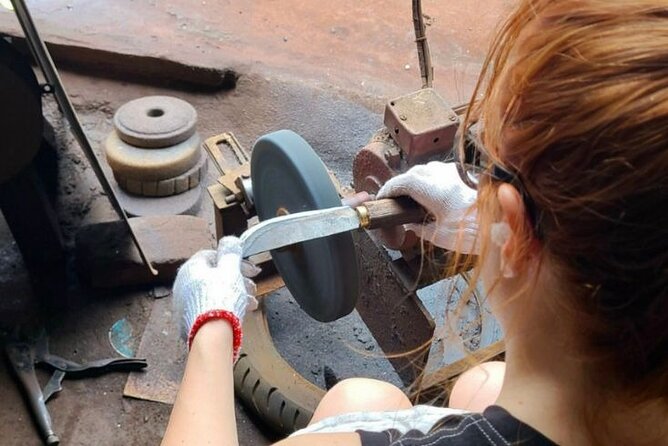
The big promise is that you don’t leave empty-handed. You take home a knife you made as part of the workshop, not just a souvenir photo.
In feedback, people frame it as a cooking-knife-style project—something more useful than a magnet. And because you choose the knife size, it’s more likely to match what you actually want in your kitchen or as a gift.
Here’s the practical part: you’re making a simple knife, and the process includes multiple steps and finishing work. Treat it like a real handmade tool. Even if you’re proud and excited, handle it carefully at the start. Think of it the way you’d think of any sharp handmade blade.
If you’re traveling light, consider your baggage plan too. A knife is compact, but it still needs safe packing for transit.
Price and Value: Is $50 a Good Deal?
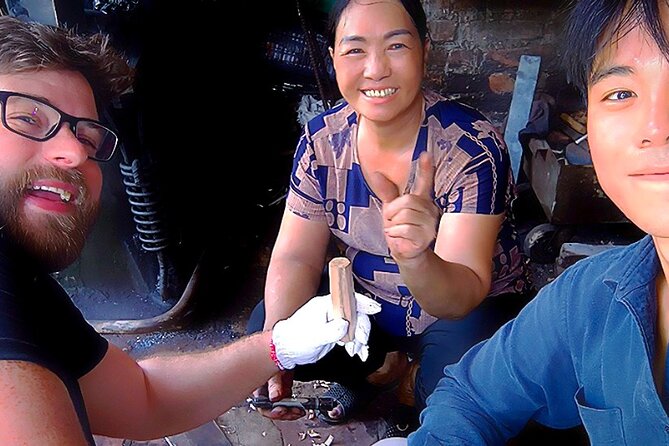
At $50 per person for about 3 hours 30 minutes, the value is tied to what’s included.
You get:
- air-conditioned vehicle (so you’re not stuck figuring out transport)
- iron material (so you’re not sourcing metal yourself)
- an English tour guide
- a capped group size of 10 travelers (so it doesn’t become a crowd event)
What’s not included:
- lunch
- tips
When I think about whether a price feels fair, I look at the ratio of instruction and materials to time. Here, you’re spending most of the workshop time directly engaged in the process, not just watching. Plus, the materials are part of the experience. For many travelers in Hanoi, that combination makes $50 feel reasonable—especially if you’re comparing it to paying for a guided class plus separate transport.
The only value snag is lunch being excluded. That isn’t a dealbreaker, but it means you should plan a meal around the 3.5-hour window.
Timing, Weather, and How to Plan Your Hanoi Day
This experience requires good weather. If it’s canceled due to poor weather, you’ll either be offered a different date or get a full refund. That’s a key planning factor in Hanoi, where conditions can change quickly.
In practice, I’d treat it like a workshop first and a sightseeing day second. If your schedule is tight, it helps to build flexibility around it. If you can, choose a day when you’re not counting on a single fixed appointment right after.
Also remember the moderate physical fitness note. You’re not doing extreme exercise, but you are actively participating in a physical process. If you’re dealing with injuries or mobility limits, this is worth thinking through before you book.
Who This Hanoi Knife Workshop Is For
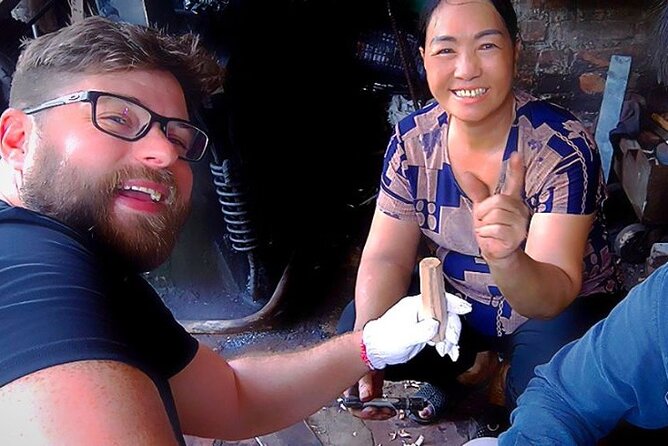
This workshop is a great match if you like hands-on learning and you’re curious about how trades actually work. It’s also strong for people who want a more authentic crafts experience than the typical souvenir hunt.
You’ll likely enjoy it if you:
- want to make an unusual, practical souvenir
- like working at your own pace with a small group
- appreciate craft history—especially a tradition that still has a real job today
- speak enough English to follow instruction, or you just want clear explanations from the guide
You might want to skip it if:
- you don’t handle physical activity for a few hours comfortably
- you’re the type who gets impatient with step-by-step work and wants instant results
- you’re not willing to plan food since lunch isn’t included
Should You Book This Hanoi Knife Making Class?
I’d book it if your idea of a good Hanoi day includes getting out of the center, meeting local makers, and learning the real process behind a tool you’ll keep. The experience feels genuinely craft-based, not staged, and the small group size helps the instruction land.
Choose it with eyes open if you’re sensitive to physical effort and if you hate planning around meals. Bring your energy, plan lunch separately, and you’ll get a memorable, unusually useful souvenir.
FAQ
Is the knife making workshop physically demanding?
The activity notes a moderate physical fitness level. You’ll be participating in the workshop process, so it’s best if you’re comfortable standing and working for a few hours.
How long does the Hanoi knife making class last?
It lasts about 3 hours 30 minutes (approx.).
Does this tour offer pickup in Hanoi?
Yes. Pickup is offered, and you travel by an air-conditioned vehicle.
What’s included in the $50 price?
The price includes the air-conditioned vehicle, iron material, and an English tour guide. Lunch and tips are not included.
How many people are in the group?
The tour has a maximum of 10 travelers.
What happens if weather is bad or you need to cancel?
If the experience is canceled due to poor weather, you’ll be offered a different date or a full refund. You can cancel for a full refund up to 24 hours in advance of the start time.
More Workshops in Hanoi


More Tour Reviews in Hanoi






Latest Hanoi write-ups from our team






Workshops, compared.
 ★ 5.0Hanoi Cooking Class: Culture, Local Market & Meaning CSR ImpactFrom $395,147 reviews
 ★ 5.05 Traditional Dishes Hanoi Cooking Class with Market TripFrom $354,890 reviews
 ★ 5.0Hanoi Coffee Workshop: Taste Salt, Coconut and Egg CoffeeFrom $161,286 reviews
 ★ 5.0Salt Coffee Workshop Awake Your Senses With 6 BrewsFrom $23792 reviews
 ★ 5.0Vietnamese Food Cooking Class in Hanoi with Market ExperienceFrom $45778 reviews
 ★ 5.0Handcrafted Wood Carving Workshop with Local ArtisanFrom $19733 reviews
 ★ 5.05 Local Dishes Cooking Class with Meal & Market VisitFrom $40420 reviews
 ★ 5.0Hanoi Cooking Class and Market Tour in Ancient HouseFrom $45379 reviews
Browse the lists this tour appears in