
Reviewed · FULL-DAY
Full-Day Hop On Hop Off Bus Tour in Hanoi
Need a fast lay of Hanoi? This hop-on hop-off bus gives you an easy way to line up the city’s big sights without fuss, and you can jump off only where you want to linger.
I like the practical onboard touches: air-conditioned comfort plus WiFi to keep your plans straight. I also appreciate that the route is built around major, walkable landmarks, so you’re not hunting for transfers all day.
One watch-out: the experience can be timing-sensitive. There are reports of ticket verification delays and occasional issues with route stops, audio syncing, or buses passing you—so keep your eye on where the bus is and have some cushion in your schedule.
In This Review
- Key things that make this Hanoi bus tour useful
- Price and what you really get for $20
- The starting point: Dong King Nghia Thuc Square (No 7 Dinh Tien Hoang)
- Stop by stop: how each landmark fits your Hanoi day
- St. Joseph Cathedral (no entrance fee) and the French-era feel
- Vietnam Military History Museum area and the Flag Tower of Hanoi
- Ba Dinh Square: Ho Chi Minh’s Mausoleum
- One Pillar Pagoda (no entrance fee) and the mini-temple wow factor
- Tran Quoc Pagoda: Hanoi’s oldest pagoda (over 1,500 years old)
- The Yên Sở area and Cua Bac Church
- Quan Thanh Temple: Taoism, and the serpent-and-turtle symbols
- Imperial Citadel of Thang Long: independence built on layered foundations
- Temple of Literature: Confucius, scholars, and Vietnam’s early university
- Hoa Lo Prison: from French political prisoners to US POWs
- Vietnamese Women’s Museum: social anthropology, 40,000+ items
- Hanoi Opera House: French colonial grandeur from 1901–1911
- Hanoi Post Office by the lake: built 1894–1899
- Getting the timing right: how to use hop-on hop-off without frustration
- Who this Hanoi bus tour is for
- Should you book this Hanoi hop-on hop-off bus?
- FAQ
- How much does the Hanoi hop-on hop-off bus cost?
- What’s the duration of the tour?
- Is the tour offered in English?
- Does the tour include WiFi and air-conditioning?
- Are entrance fees included for all stops?
- Do I need hotel pickup and drop-off?
- Should I bring a reusable bottle?
- Is free cancellation available?
Key things that make this Hanoi bus tour useful

- Hop-off flexibility in a single day: You choose how much you do at each stop, instead of getting locked into a rigid pace.
- English audio and onboard WiFi: Helpful for orientation, especially when you’re bouncing between French-era sites, pagodas, and museums.
- A start in the Dinh Tien Hoang area: Convenient for building an itinerary that mixes central sights with a few farther stops.
- Free entry at select temples/churches: St. Joseph Cathedral and the One Pillar Pagoda are highlighted with no entrance fee.
- Bring your own reusable bottle: The operator pushes refilling from a 20-liter water container to cut plastic use.
Price and what you really get for $20
At $20 per person, this is the kind of deal that works when you’re short on time and want maximum options. You’re paying mainly for the logistics: an air-conditioned vehicle, onboard WiFi, insurance, a city map, and the ability to hop off and back on.
What you do need to budget for is ticketed entry at several stops. Some big names are not included, including Ho Chi Minh’s Mausoleum and Hoa Lo Prison, plus fees for Tran Quoc Pagoda, Quan Thanh Temple, Imperial Citadel of Thang Long, Temple of Literature & National University, and the Vietnamese Women’s Museum. St. Joseph Cathedral and the One Pillar Pagoda are called out as no entrance fee, which helps your cost control.
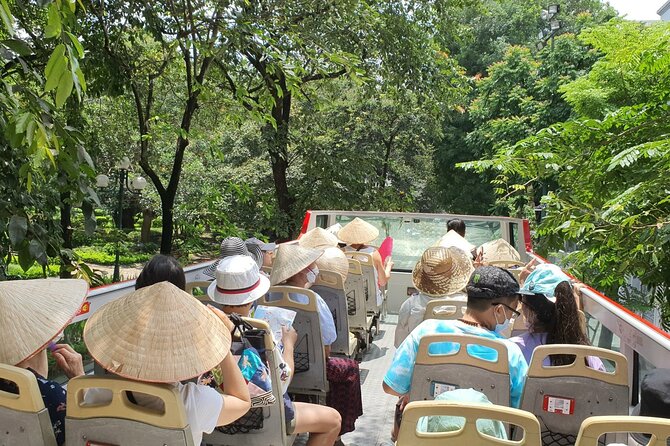
Also note the operator includes weather gear: a conical hat and a rain coat. In Hanoi, that’s not a gimmick. You’ll often feel a breeze off the streets, and sudden rain can turn a planned walk into a scramble.
Worth a glance beside this Hanoi pick:
- Ninh Binh Full-Day Tour from Hanoi to Hoa Lu, Tam Coc & Mua Cave Via Boat & Bike
★ 5.0 · 4,384 reviews



The starting point: Dong King Nghia Thuc Square (No 7 Dinh Tien Hoang)

Your day begins at Dong King Nghia Thuc Square, No 7 Dinh Tien Hoang, where you’ll find the meeting point and ticket box. This matters because central pickup points reduce the time you spend commuting before you even begin sight-seeing.
If you’re using a mobile ticket, plan a little extra patience at the ticket box. One common snag in the experience is verification taking longer than expected, especially when bookings come through third-party platforms. That doesn’t mean it will be a problem for you, but it’s smart to arrive a bit early so your first bus ride doesn’t turn into a stress test.
Stop by stop: how each landmark fits your Hanoi day
St. Joseph Cathedral (no entrance fee) and the French-era feel
St. Joseph Cathedral is one of the stops people like because it’s easy to enjoy without extra paperwork: the cathedral itself has no entrance fee. Built in 1884 and opened in December 1886, it’s described as having an architecture style resembling Notre Dame de Paris, and it’s considered the oldest church in Hanoi.
Why this works on a hop-on hop-off day: you can do a quick photo loop, check out the façade, and then move on. If you have limited time, this is the kind of stop that doesn’t force a long commitment.
Potential drawback: because it’s free and central, it can be busy. Think of it as a “hit it and keep going” stop unless you specifically want to linger.
Vietnam Military History Museum area and the Flag Tower of Hanoi
This stop highlights the Flag Tower of Hanoi, a rare surviving structure tied to Hanoi Citadel that survived French domination from 1894 to 1897. It’s been around for nearly 200 years, and it’s treated as a historic symbol of the city.
Even if you don’t go deep into museum details, the flag tower moment gives you a good visual anchor. Hanoi’s layers show up fast when you can point to something that visibly bridges eras.
Practical tip: museums tend to have rules and varying time windows, but your hop-on hop-off setup lets you adjust. If the timing doesn’t feel right, you can still get the exterior/area orientation and move on.
- Hanoi Motorbike Tour: Food, Culture and Fun by Vintage Motorbike★ 5.0 · 6,699 reviews
- Hanoi: Guided Food Tour with Train Street Visit★ 4.9 · 6,239 reviews
- Hanoi Cooking Class: Culture, Local Market & Meaning CSR Impact★ 5.0 · 5,147 reviews
Ba Dinh Square: Ho Chi Minh’s Mausoleum
This is the headline civic stop: Ho Chi Minh’s Mausoleum sits on Ba Dinh Square, and it’s described as the resting place of Ho Chi Minh. The info provided also connects it to the Declaration of Independence on 2 September 1945, which is a big part of the story behind this location.
But here’s the reality for your planning: the mausoleum has an entrance fee listed as 25,000 VND and is a major attraction with its own visitor flow. When you’re hopping between sites, you want to avoid stacking too many “musts” at the same time of day. If you’re set on going inside, build extra buffer and don’t rush your return to the bus.
One Pillar Pagoda (no entrance fee) and the mini-temple wow factor
The One Pillar Pagoda is explained as a temple built on one pillar, originally from 1049, with additions and perfecting in 1105. It’s considered one of Vietnam’s two iconic temples (paired with Perfume Temple).
This is one of those rare attractions where the idea is the main reason it’s memorable. You don’t need hours; you need attention. You can often see what makes it special fairly quickly, which makes it ideal for hop-on hop-off timing.
Since it’s marked as no entrance fee, it’s also a strong value stop. The only consideration is crowding: popular spots can feel tight, so go with a calm pace and plan for short waits.
Tran Quoc Pagoda: Hanoi’s oldest pagoda (over 1,500 years old)
Tran Quoc Pagoda is presented as the oldest pagoda in Hanoi, originally constructed in the sixth century (544–548), during the reign of Emperor Ly Nam De—so you’re looking at more than 1,500 years.
If you like your travel with a slow, reflective tone, this stop is a good switch from the civic squares and museum moods. Pagodas reward walking slowly and noticing details.
Value tip: because the tour lists a separate entry fee of 5,000 VND for this pagoda, you can plan a cleaner day by deciding in advance whether you’ll pay to go inside or focus on the area around it.
The Yên Sở area and Cua Bac Church
One stop name points to Công viên Yên Sở (Yên Sở Park), and the accompanying description focuses on Cua Bac Church. That church is described as a Roman Catholic church built in 1932 by the French administration of Indochina, as part of Hanoi’s urban plan supervised by Ernest Hébrard.
Even with the route description slightly mismatched in labeling, the takeaway is clear: you’re being directed toward a distinct colonial-era Catholic landmark, tied to planning under Hébrard.
What to expect: this can feel like a breather stop. If you’re taking the day at a comfortable pace, it’s a nice point where the architecture and city planning details become the theme rather than the major national sites.
Quan Thanh Temple: Taoism, and the serpent-and-turtle symbols
Quan Thanh Temple is tied to Emperor Ly Thái To (1010–1028) and dedicated to Tran Vu, the deity of the North in Taoism. The symbols of power mentioned are the serpent and turtle, and the temple is described as one of the Four Sacred Temples meant to protect the capital from malevolent spirits.
This stop rewards you if you like cultural logic—how societies map meaning onto geography. Taoist temple design isn’t just decoration; it’s an idea system made visible.
Cost note: there’s a 10,000 VND entrance fee listed for Quan Thanh Temple. If you want to keep your budget predictable, decide early whether you’ll include this one.
Imperial Citadel of Thang Long: independence built on layered foundations
The Thang Long Imperial Citadel is described as built in the 11th century by the Ly Viet Dynasty, marking the independence of Dai Viet. It was constructed on remains of a Chinese fortress from the 7th century, on land reclaimed from the Red River Delta.
This is a strong stop for understanding Hanoi as a city built in layers. You’ll get the sense that this place has been strategic for a long time.
Entrance fee for this stop is listed as 30,000 VND. Since it’s ticketed, it’s worth prioritizing if you care about the long story behind Hanoi’s identity—and worth skipping if your day is already tight.
Temple of Literature: Confucius, scholars, and Vietnam’s early university
Van Mieu is described as a temple dedicated to Confucius, and it also hosts the Imperial Academy, Vietnam’s first national university. The temple was built in 1070 under Emperor Ly Thanh Tong.
This stop can feel different from the others because it’s about learning, exams, and the institutions that shaped social mobility. If you enjoy cultural context, this is where the trip gives you real depth.
The tour lists an entry fee of 30,000 VND for Temple of Literature & National University. Plan for a walking day even if you’re using the bus—this is one of those complexes where time slips away.
Hoa Lo Prison: from French political prisoners to US POWs
Hoa Lo Prison is described in two major phases: first as a French colonial prison for political prisoners, then later used by North Vietnam for U.S. prisoners of war during the Vietnam War. American POWs called it the Hanoi Hilton. The prison was later demolished in the 1990s, with a remaining gatehouse museum.
This stop is heavy in topic, and that’s precisely why it matters. If your Hanoi trip includes national history, you’ll want a place like this where the story is told on-site.
There’s an entrance fee listed as 30,000 VND for Hoa Lo Prison. If you’re sensitive to intense historical settings, schedule this earlier in the day so you can reset afterward rather than carrying it into your evening.
Vietnamese Women’s Museum: social anthropology, 40,000+ items
The Vietnamese Women’s Museum opened to the public in 1995 and is operated by the Vietnam Women’s Union. It’s described as holding more than 40,000 materials and artifacts, with permanent exhibits plus thematic shows using an approach tied to social anthropology.
This is the stop that adds a more personal lens to a day otherwise heavy with monuments. If you want Hanoi beyond flags and dates, this is where you’ll often feel the city as everyday life and social change.
Cost note: the listed entrance fee is 40,000 VND. That makes it more of a deliberate choice than a quick stop.
Hanoi Opera House: French colonial grandeur from 1901–1911
The Hanoi Opera House was erected by French colonial administration between 1901 and 1911. It’s described as one of three opera houses the French built in Indochina (with Haiphong and a theater in Ho Chi Minh City).
Why include this on a hop-on hop-off day: even if you don’t attend a performance, the building adds a visual break from temples and memorial sites. It’s one of those places where you stop just to look up.
No entrance fee is listed specifically for the opera house in the tour details, so you can treat it as mostly an exterior and area stop unless you’re planning something else.
Hanoi Post Office by the lake: built 1894–1899
At 75 P. Dinh Tien Hoang, the tour highlights the Hanoi Post Office, described as more than 100 years old and designed/built by Henri Vildieu from 1894 to 1899. It’s known as the familiar Post office by the lake.
This is a great last-day anchor because post offices are practical places with an identity. You can buy a postcard, stand in the lobby, and notice the structure’s neoclassical style.
If you want to use your day efficiently, this can also act as a rendezvous point: you’ve reached the central loop again, and you can hop on one more time if you missed anything earlier.
Getting the timing right: how to use hop-on hop-off without frustration
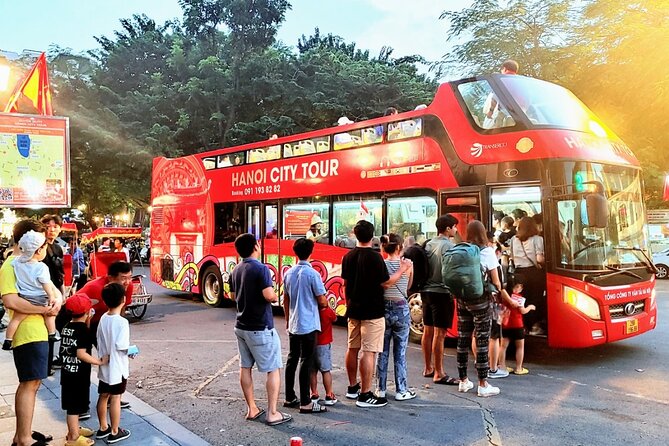
Hop-on hop-off works best when you treat it like transportation, not a promise. The operator notes the route can change because of traffic issues, public holidays, weather, and unforeseen circumstances. That’s normal in any big city, but in Hanoi you’ll feel it as delays or altered paths.
Here’s how I’d play it:
- Plan one paid “big interior” per day, then let the free spots fill gaps.
- Keep your phone ready and check the bus location timing, since there are reports of buses waving off or not stopping as expected at some points.
- If your audio guide matters, don’t rely on it as a perfect match to the exact street corner. One issue reported is audio not always being in sync with location.
Also, the tour includes a note about sustainability: the operator supplies a 20-liter water container and you refill a reusable bottle. You also get paper cups. In practice, that means you don’t want to arrive empty. Bring your bottle and use the refills so you’re not forced into buying drinks every time you hop off.
Who this Hanoi bus tour is for
This is a smart choice if you:
- Want a first-day orientation around major landmarks, then decide later where to return.
- Prefer self-paced sightseeing but still want an easy route without constant taxis.
- Like a mix of civic history (Ba Dinh), religion (pagodas), and architecture (opera house, post office).
It’s not the best fit if you:
- Need ultra-reliable timing at every stop, because route changes and operational hiccups can happen.
- Only want museums with zero walking. Some stops can involve short walks from the bus area to the entrance.
Should you book this Hanoi hop-on hop-off bus?

I think it’s a good buy for most visitors because $20 buys you mobility plus comfort plus a structured circuit. The big value win is that several major attractions are included as stops with no entrance fee (St. Joseph Cathedral and One Pillar Pagoda), and the rest are at least clearly labeled with separate entry costs so you can budget.
But if your schedule is tight or you’re counting on specific exact times for a ticketed site like Ho Chi Minh’s Mausoleum or Hoa Lo Prison, you’ll want a little breathing room. If you can handle that, this bus is an efficient way to see the core of Hanoi without turning your day into a puzzle.
FAQ
How much does the Hanoi hop-on hop-off bus cost?
It’s listed at $20.00 per person.
What’s the duration of the tour?
The duration is about 1 day.
Is the tour offered in English?
Yes, it’s offered in English.
Does the tour include WiFi and air-conditioning?
Yes. The tour includes WiFi on board and an air-conditioned vehicle.
Are entrance fees included for all stops?
No. Some stops have separate entrance fees (like Ho Chi Minh’s Mausoleum, Hoa Lo Prison, and the Imperial Citadel of Thang Long). St. Joseph Cathedral and the One Pillar Pagoda are specifically noted as having no entrance fee.
Do I need hotel pickup and drop-off?
Hotel pickup and drop-off are not included.
Should I bring a reusable bottle?
Yes. The operator supplies water for refilling, and you’re asked to bring your own reusable bottle to refill.
Is free cancellation available?
Yes. You can cancel up to 24 hours in advance for a full refund.
If you want, tell me your travel dates and whether you want more history or more temples, and I’ll help you map a realistic order of stops so you don’t waste time hopping back and forth.
More Full-Day in Hanoi
- Ninh Binh Full-Day Tour from Hanoi to Hoa Lu, Tam Coc & Mua Cave Via Boat & Bike
★ 5.0 · 4,384 reviews


More Tours in Hanoi
- Ninh Binh Full-Day Tour from Hanoi to Hoa Lu, Tam Coc & Mua Cave Via Boat & Bike
★ 5.0 · 4,384 reviews




More Tour Reviews in Hanoi


Latest Hanoi write-ups from our team





Full-Day, compared.
 ★ 5.0Full-Day Ninh Binh Highlights Tour from HanoiFrom $797,761 reviews
 ★ 5.0Ninh Binh Full-Day Tour from Hanoi to Hoa Lu, Tam Coc & Mua Cave Via Boat & BikeFrom $334,384 reviews
 ★ 5.0Ninh Binh Full-Day Small Group of 9 Guided Tour from HanoiFrom $851,422 reviews
 ★ 5.0Lan Ha Bay full-day tour from Hanoi, Hai Phong – Serenity CruisesFrom $48958 reviews
 ★ 5.0Halong Bay Full Day with Kayaking, Hiking viewpoint, Cave – Deluxe To LuxuryFrom $38884 reviews
 ★ 5.0Halong Bay Full Day With Cave, Kayaking And Swimming – Highway TransferFrom $39743 reviews
 ★ 4.9From Hanoi: Full-Day Ninh Binh Highlights Small Group TourFrom $89614 reviews
 ★ 5.0Highlight Ninh Binh Full Day Tour Tam Coc Boat, Mua Cave, Hoa LuFrom $41517 reviews