
Reviewed · WALKING TOURS
Hanoi Highlights and Hidden Gems Walking Tour
Hanoi in three hours? Yes, it’s doable. This small-group walking tour turns the Old Quarter into a story you can walk through, from Đồng Xuân Market to the Hanoi Opera House, with stops that mix everyday life, photo-worthy oddities, and real historical context. I especially like how the route balances major landmarks with quieter side streets, and I love the chance to see photo hotspots like Đường Tàu without feeling like you’re rushing. One thing to consider: you’ll be on the move for about 3 hours, and the tour depends on good weather.
If you’re new to Hanoi, you’ll likely appreciate getting a clean sense of direction fast. And if you’re more history-minded, you’ll get enough background to make famous places feel less random. Guides like Son have been praised for being flexible, so the walk can feel less like a script and more like you’re learning the city with a good friend.
In This Review
- Key highlights worth planning for
- A 3-hour Old Quarter walk that feels practical, not performative
- Price and what you actually get
- Đòng Xuân Market: where the tour begins and the city makes sense
- What to watch for during the market start
- Phùng Hưng Mural Street: Korean Friendship art with photo-friendly angles
- Why this stop is more than a photo break
- Đường Tàu: the train line scene that explains everyday Hanoi
- How to enjoy Đường Tàu without getting stressed
- Hương Phựng: a preserved French Indochina building in the Old Quarter
- A quick tip for this stop
- St. Joseph’s Cathedral: largest Roman Catholic church, plus war history
- Why this matters even if churches aren’t your thing
- Hoàn Kiếm Lake walking street: the sword story tied to local meaning
- How to get more from this stop
- Lý Thái Tổ Park: statue stop with a city-moving backstory
- Hanoia Metropole (Sofitel Metropole): Joan Baez in 1972
- Why I like this kind of stop
- Hanoi Opera House finish: August uprising, summer 1945
- The feeling at the end
- Logistics that matter: how to plan your day around the walk
- What to wear and bring
- Who this tour fits best (and who might want something else)
- Should you book this Hanoi highlights-and-corners walking tour?
- FAQ
- Where does the tour start?
- Where does the tour end?
- What time does the tour begin?
- How long is the walking tour?
- How much does the tour cost?
- Is it a small group?
- Do I need admission tickets for the stops?
- Is a mobile ticket included?
- What happens if the weather is bad?
- Are there any booking limits or changes allowed?
Key highlights worth planning for
- Đồng Xuân Market start: You begin where locals actually trade, not just where tourists take photos.
- Phùng Hưng Mural Street: Cultural gift art that’s built for great pictures and easy wandering.
- Đường Tàu train-track stop: Watch the train slip past near houses for a very Hanoi kind of scene.
- Hương Phựng French-era building: A well-preserved French Indochina structure in the middle of the Old Quarter.
- Hoàn Kiếm Lake sword legend: A story stop that explains why locals care about this landmark.
- War-era stories at major landmarks: St. Joseph’s Cathedral and the Opera House give you dates and meaning, not just architecture.
A 3-hour Old Quarter walk that feels practical, not performative

This tour is priced at $15 per person, which is a big part of why it works. You’re not paying for a fancy ride or a long day—just a focused way to see central Hanoi on foot, with a guide who connects streets to history. With max 15 travelers, you’re unlikely to get stuck behind a giant crowd, and that makes the smaller alley stops easier to enjoy.
The schedule is built around a morning start (9:30am) and a steady walking pace through the Old Quarter area. It’s a good length for your first day if the city feels chaotic when you arrive. You’ll walk out with a mental map, a few stories you’ll remember, and several spots you can return to later.
More of Hanoi covered on foot




Price and what you actually get
For the money, what you’re buying is interpretation. All the listed stops are shown as admission-free, so you’re not juggling ticket costs. What you will be doing is listening to how the city got shaped—plus taking in visual landmarks that are hard to understand on your own from street-level.
Đòng Xuân Market: where the tour begins and the city makes sense
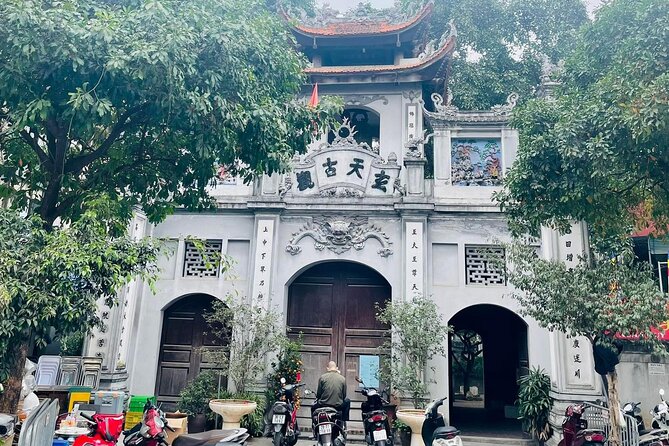
You start at Đồng Xuân Market, a lively, practical hub in the center of Hanoi. The advantage here is obvious: before you even hit the most famous sights, you’re learning the city’s background from a place locals use. The tour framing also points to conflict history around the wider Hanoi area, giving you context that you can tie to later stops.
It’s a short stop (about 20 minutes), so don’t expect a full market experience. Instead, think of it as orientation with flavor—where you get the first layer of Hanoi’s character and then keep walking.
What to watch for during the market start
Keep your eyes open for how busy streets and narrow lanes funnel movement. That street logic matters later when you’re moving through the Old Quarter’s smaller passages and suddenly everything clicks.
Phùng Hưng Mural Street: Korean Friendship art with photo-friendly angles
Next up is Phùng Hưng Mural Street, an art wall designed as a gift for friendship from the Korean Government. This is one of those stops that works even if you’re not a hardcore art person. It gives you a break from temple-and-church focus, and it’s also a quick way to get satisfying photos without hunting.
Plan for about 20 minutes here. The time is enough to walk the length, grab a few angles, and read what the guide points out.
- Hanoi Jeep Tour: Food, Culture and Fun by Vietnam Army Jeep★ 5.0 · 15,222 reviews
- Full-Day Ninh Binh Highlights Tour from Hanoi★ 5.0 · 7,761 reviews
- Hanoi: Ha Long Bay Day Cruise – Swimming, Meal, Kayaking★ 4.7 · 7,415 reviews
Why this stop is more than a photo break
Murals like this are public diplomacy made visible—easy to ignore if you’re rushing, meaningful if you slow down. The guide’s explanations help the street art feel less random and more like part of Hanoi’s ongoing relationships with the world.
Đường Tàu: the train line scene that explains everyday Hanoi
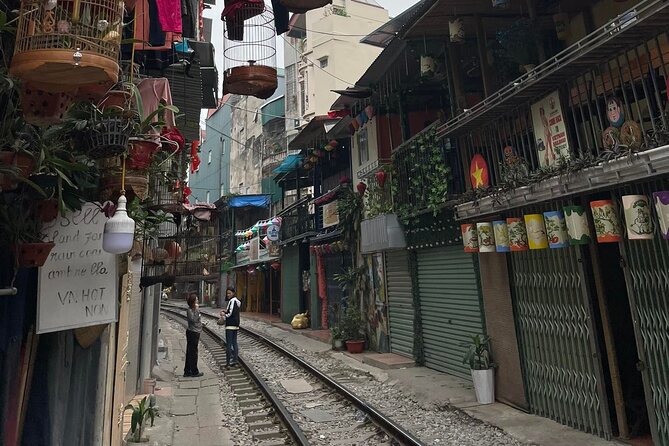
Then comes a stop that many people associate with Hanoi visuals: Đường Tàu. The key moment is simple—this is where you can see the local train pass by some nearby houses. You’ll get time for photos and video of the tracks in action, and it’s exactly the kind of street scene that’s hard to describe until you see it.
You’ll spend about 25 minutes here, which is important. Watching the train take its path takes timing, and more than a few minutes is useful if schedules vary on the day you go.
How to enjoy Đường Tàu without getting stressed
Go in expecting that it’s an active area. Keep your eyes on your footing on the sidewalk and don’t block pedestrian flow while filming. The payoff is that you’re seeing Hanoi as it runs—not as it’s posed for visitors.
Hương Phựng: a preserved French Indochina building in the Old Quarter
The tour shifts back to architecture with Hương Phựng, described as the most well-preserved French Indochina building in the Old Quarter. The time here is about 15 minutes, so you’re not doing an extended museum visit. Instead, you’re spotting what makes the building distinctive and learning how that European-era influence shaped what you see today.
This is a great stop if you like contrasts: modern street life around older structures. Even if you’re not a detail-spotter, the guide helps you identify what’s significant about the facade and setting.
A quick tip for this stop
Treat it like a photo-and-lesson moment. If you wait too long trying to “study” the building, the tour will move on—so grab one good overview shot early, then listen for the explanation.
St. Joseph’s Cathedral: largest Roman Catholic church, plus war history
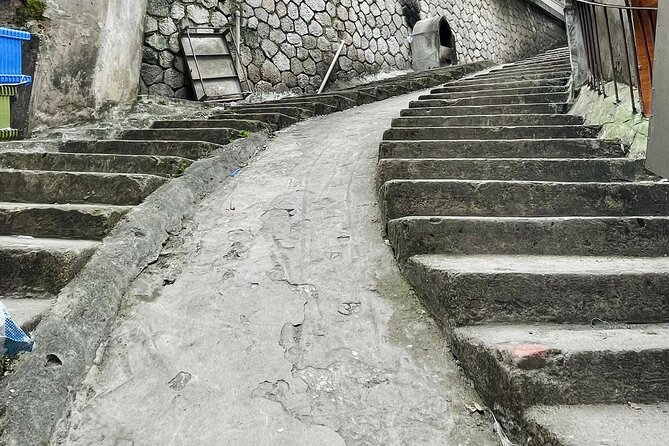
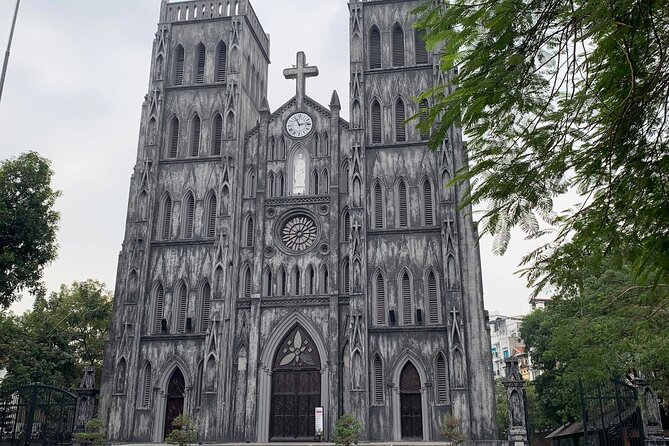
St. Joseph’s Cathedral is one of the tour’s most meaningful segments. You’ll hear stories about the church and learn that it is the largest Roman Catholic church in Hanoi. You’ll also get the uncomfortable part of the story: how it was shut down for more than 20 years during the Vietnam War.
The stop is about 15 minutes, which means you’ll get the essentials and the meaning, not an all-day church deep-stare. Still, the dates and the interruption to normal life help you understand why this building sits in Hanoi’s memory so firmly.
Why this matters even if churches aren’t your thing
Architecture is never only design. Buildings like this are also records of how conflict changes daily life. The guide’s narrative helps you see the cathedral as a landmark with a lived history, not just a scenic backdrop.
Hoàn Kiếm Lake walking street: the sword story tied to local meaning
Next is Hoàn Kiếm Lake Walking Street, with a stop time of about 15 minutes. You’ll hear the story connected to the sword and the lake, and the emphasis here is meaning—why this spot matters to locals, beyond the postcard view.
This is a strong pause point because the area naturally slows people down. Even if you’re moving as part of a tour group, the lakefront atmosphere makes it easier to breathe for a moment.
How to get more from this stop
Look at the lake from a couple of angles instead of one. The guide’s story sticks better when you also connect it to what you can see in front of you.
Lý Thái Tổ Park: statue stop with a city-moving backstory

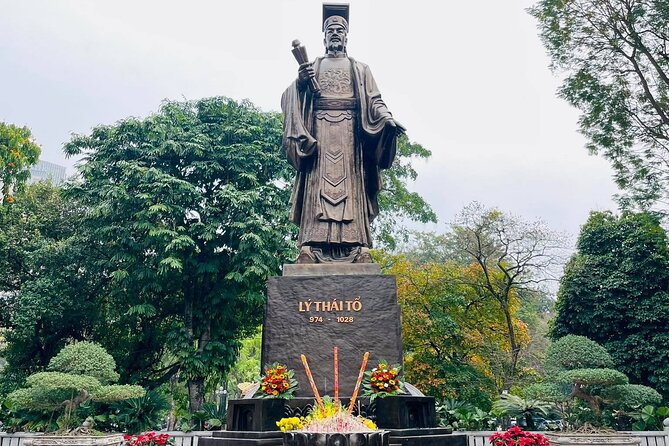
At about 15 minutes, the tour heads to Ly Thai To Park, centered on the statue of the 3rd King of Vietnam, tied to the moment when the capital shifted to what is now known as Hanoi. This stop is short, but it adds a big-picture layer.
If you’re the kind of traveler who wonders why the city feels the way it does, this kind of political-history anchor helps. It’s easier to understand later landmarks when you know the city’s founding story isn’t just a tourist myth.
Hanoia Metropole (Sofitel Metropole): Joan Baez in 1972
The tour then includes a stop related to Hanoi Metropole—linked to the Sofitel Metropole Hotel. Here you’ll hear a story about Joan Baez, the American folk singer and activist, who was a guest of the hotel over Christmas in 1972.
This is the kind of stop that surprises people who think Hanoi history only lives in temples and old fortifications. A hotel guest story like this shows how Hanoi intersected with international culture and political attention in the early 1970s.
Why I like this kind of stop
It gives you a reminder that Hanoi wasn’t isolated. Even in a city known for old streets, international lives touched it—sometimes right in places modern visitors pass by.
Hanoi Opera House finish: August uprising, summer 1945
You end at the Hanoi Opera House, where the tour notes the August uprising took place in summer 1945. This makes a strong finish because you’re not just leaving a landmark—you’re leaving with a timeline in your head.
The stop is about 20 minutes. At this point, you’ve walked through markets, murals, war-era architecture, legends, and a few “how does this even exist” street scenes. Ending at a political-historical moment brings it all together.
The feeling at the end
It’s a satisfying closing arc: you start at a working city hub, then move through layers of identity, and finish at a place tied to national turning points.
Logistics that matter: how to plan your day around the walk
This is a 3-hour walking tour with a 9:30am start. That timing is handy because the morning light often makes photography easier, and the Old Quarter can be less intense earlier in the day than later.
The tour is designed for most travelers, and the group size is capped at 15. It also states service animals are allowed, and the meeting and end points are in central areas with near public transportation, so you’re not forced into a complicated journey.
What to wear and bring
- Wear shoes you trust on uneven sidewalks and curb edges.
- Bring water, because the day will keep going after your 3-hour walk.
- If you’re filming at Đường Tàu, keep your phone stable and your steps careful.
Who this tour fits best (and who might want something else)
This is a great pick if you’re arriving in Hanoi and want a guided route that helps you navigate the center. It’s also solid if you like a mix—architecture, religion, street culture, and war-era stories—without needing a full-day commitment.
You might want to consider a different type of tour if you hate walking or if you prefer long stays at fewer sites. This one keeps moving and uses short stop times (often 15–20 minutes) so you see more, but you don’t linger like a museum visit.
Should you book this Hanoi highlights-and-corners walking tour?
If you’re looking for value—$15 for about three hours with a knowledgeable guide and a route built around real city locations—this is an easy yes. The best reason to book is the mix: you get headline sights like St. Joseph’s Cathedral and the Opera House, plus street-level stops like Đường Tàu that make the city feel specific, not generic.
I’d book it if it’s your first time in Hanoi, or if you want one guided morning to set up the rest of your trip. Just keep in mind the weather requirement and plan to walk at a steady pace.
FAQ
Where does the tour start?
It starts at Đồng Xuân Market (Chợ Đồng Xuân, Đồng Xuân, Hoàn Kiếm, Hà Nội 100000, Vietnam).
Where does the tour end?
It ends at the Hanoi Opera House (1 Tràng Tiền, Phan Chu Trinh, Hoàn Kiếm, Hà Nội, Vietnam).
What time does the tour begin?
The start time is 9:30 am.
How long is the walking tour?
The tour lasts about 3 hours.
How much does the tour cost?
The price is $15.00 per person.
Is it a small group?
Yes. The tour has a maximum of 15 travelers.
Do I need admission tickets for the stops?
The listed stops show admission ticket free for each segment, so you should not expect paid entries for these stops.
Is a mobile ticket included?
Yes, the tour uses a mobile ticket.
What happens if the weather is bad?
The experience requires good weather. If it’s canceled due to poor weather, you’ll be offered a different date or a full refund.
Are there any booking limits or changes allowed?
Confirmation is received within 48 hours (subject to availability). It’s also non-refundable and cannot be changed for any reason.
If you want, tell me your travel dates and whether you’re into architecture, history, or photos most—I can help you pick the best time to fit this into your Hanoi schedule.
More of Hanoi, Step by Step


More Tours in Hanoi
- Ninh Binh Full-Day Tour from Hanoi to Hoa Lu, Tam Coc & Mua Cave Via Boat & Bike
★ 5.0 · 4,384 reviews






More Tour Reviews in Hanoi


Latest Hanoi write-ups from our team




Walking Tours, compared.
 ★ 5.0[HOT] Hanoi Old Quarter Walking Street Food – Small Group TourFrom $142,163 reviews
 ★ 5.0Private Walking Tour of Hanoi CityFrom $51,251 reviews
 ★ 4.8Small-Group Street Food Walking TourFrom $151,165 reviews
 ★ 5.0Private Hanoi Street Food Walking Tour With Real FoodieFrom $361,042 reviews
 ★ 4.8Michelin Guide Street Food Walking TourFrom $19961 reviews
 ★ 5.0Hanoi Walking Street Food Tour with Train-Street VisitFrom $18857 reviews
 ★ 5.0Ha Noi Walking Food Tour, Non Vegetarian,Vegan, vegetarian OptionFrom $38846 reviews
 ★ 5.0Tasting 8 Different Street Foods + Local Drink at Evening Time by WalkingFrom $28830 reviews
Browse the lists this tour appears in